
There’s something alluring about being told not to do something. Even when the warnings are valid and rooted in real concern, there’s still that quiet pull to lean in closer and see for yourself what everyone else is stepping away from. Maybe it’s curiosity. Maybe it’s stubbornness. Or maybe it’s the belief that some experiences are worth understanding firsthand.
That’s how we found ourselves in Ukraine.
This wasn’t a reckless decision or a spontaneous leap into the unknown. Mark and I didn’t ignore the risks. We sat with them. We read, we listened, and we asked questions. We tried to understand not just the headlines, but the reality of what it might mean to go. Somewhere in that process, the question shifted from “Is this a bad idea?” to “Is this something we’re meant to do?”
Because the truth is, Ukraine isn’t just a place defined by conflict. Yes, it’s a country that has endured more than its share of struggle, with a history shaped by resilience, tension, and survival. But it’s also a place full of people, culture, connection, and everyday life continuing in the face of uncertainty. That mattered to us.
Spending five months in Romania planted the first seed. Living there, alongside my dear friend and roommate, reshaped my sense of proximity to places the world often labels as “too dangerous.” What once felt distant and abstract started to feel human and reachable. Ukraine no longer existed only as a news story. It was right next door, real and present.
Then came another personal connection. When Mark began volunteering with ENGin and was paired with a Ukrainian student, everything shifted again. What started as a language exchange quickly grew into a genuine friendship. Suddenly, this wasn’t just about a country. It was about people. People we cared about. People whose life was directly shaped by the situation we had only been observing from afar.
At that point, going to Ukraine stopped feeling like a bold or unusual idea. It started to feel necessary.
Not because we thought we could fix anything. Not because we believed our presence would change the course of events. But because showing up, listening, learning, witnessing, and offering even the smallest form of support felt more meaningful than staying away out of fear.
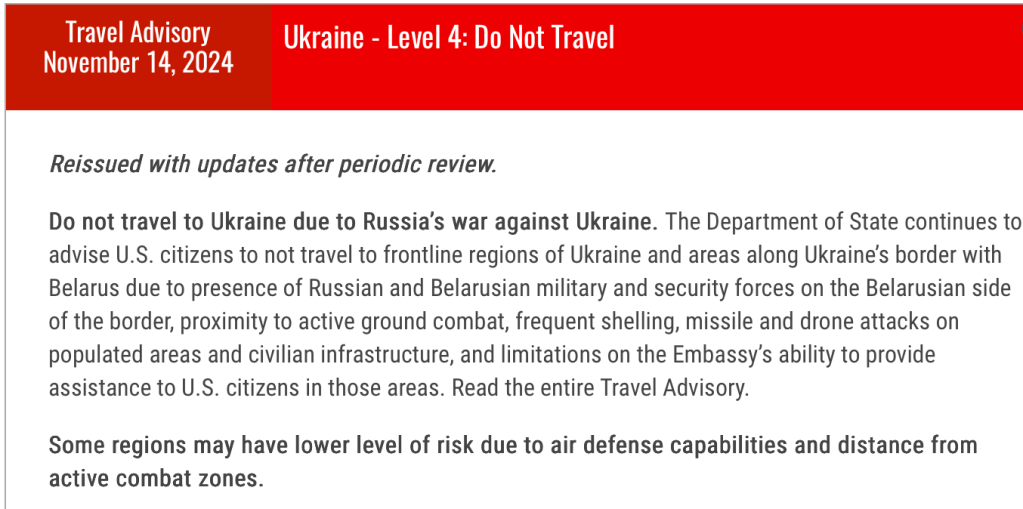
The warnings never went away. They were everywhere, especially on the Department of State website, spelled out in clear, serious language under bold, red banners. And when we told people about our plans, the reactions were often the same. Some looked at us like we were reckless, or worse, like we had a death wish. A few conversations were so uncomfortable that I chose not to have them at all. Even with close family, I waited until the last possible moment to share what we were doing.
It’s easy for people to form assumptions about a country at war. From a distance, it can feel like everything has stopped, like life has been put on hold indefinitely. But that isn’t the full picture.
Life is still moving forward.
People wake up and go to work. Students show up to school. Couples fall in love and get married. Families welcome new babies. People start new jobs, make plans, and continue building their lives in the middle of uncertainty. There is still rhythm, still routine, still hope woven into everyday moments.
And those people, living their lives in the midst of it all, deserve to be seen as more than just a headline.
Sometimes, the things we’re warned against deserve to be questioned, not dismissed but explored with intention. And sometimes, stepping closer rather than backing away is exactly what leads you where you’re meant to be.
 Run. Sip. Serve.
Leave a comment